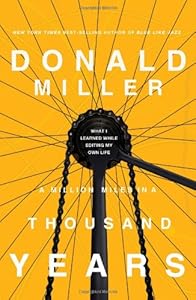
It isn't often that someone loans me a book and I go buy my own copy before I've finished reading the loaner. The exception came with "A Million Miles in a Thousand Years" by Donald Miller. I started reading it on a flight home from Denver, got about halfway through it, and went out the next day and bought three copies -- one for myself and two that I plan to give to friends.
Miller wrote "Blue Like Jazz" -- a fine memoir -- and a few other books that I haven't read. But he outdid himself with "A Million Miles." It's a story about story, which, as you might image, is the type of story a writer might enjoy. So I learned something about writing and telling stories, which is good. More than that, Miller picked up on one of my favorite themes: Life as story.
In short, Miller realized he wasn't happy with the story he was living. So as he studied and wrote about story, he helped himself (and thus his readers) see how to live a better story.
Benjamin Franklin once said, "If you would not be forgotten as soon as you are dead, either write things worth reading or do things worth writing." Miller challenges me to do both.
Wednesday, April 21, 2010
Sunday, April 04, 2010
The Means to Millions
The headline — "Five Billionaires Who Live Below Their Means" — seemed to imply that some billionaires live beyond their means. Of course, if they lived beyond their means, they wouldn't be billionaires. Still, the article was a interesting series of snapshots, because there's a lot to learn by looking at what these billionaires do and don't do with their money.
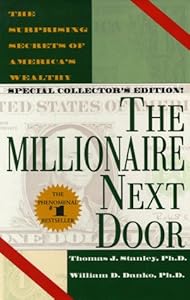
Several years ago, I learned some valuable lessons about wealth from a book called The Millionaire Next Door. First, it defined a millionaire as someone whose net worth equaled more than a million dollars. So living in a $2 million home and owning a jet and a yacht and several expensive cars doesn't make you a millionaire. In fact, most people who live extravagant lifestyles are heavily leveraged with debt. In short, they owe more than they own. Second, it offered a great many insights, all based on researching the spending and saving habits of millionaires, about how millionaires become millionaires.
As you'd expect, being smart helps. And working hard is essential. But neither is enough.
Here's the myth: Some really wealthy people live frugally despite their great wealth.
Here's the truth: Most really wealthy people are really wealthy because they live frugally.
The other great truth I learned about millionaires is that they are givers — not just after they reach certain levels of wealth but regardless of their levels of wealth. They gave when they had very little and they continued to give as their net worth grew.
So the lessons I take from all of this are simple: Work hard, give generously, and live frugally.
Cover of The Millionaire Next Door
Several years ago, I learned some valuable lessons about wealth from a book called The Millionaire Next Door. First, it defined a millionaire as someone whose net worth equaled more than a million dollars. So living in a $2 million home and owning a jet and a yacht and several expensive cars doesn't make you a millionaire. In fact, most people who live extravagant lifestyles are heavily leveraged with debt. In short, they owe more than they own. Second, it offered a great many insights, all based on researching the spending and saving habits of millionaires, about how millionaires become millionaires.
As you'd expect, being smart helps. And working hard is essential. But neither is enough.
Here's the myth: Some really wealthy people live frugally despite their great wealth.
Here's the truth: Most really wealthy people are really wealthy because they live frugally.
The other great truth I learned about millionaires is that they are givers — not just after they reach certain levels of wealth but regardless of their levels of wealth. They gave when they had very little and they continued to give as their net worth grew.
So the lessons I take from all of this are simple: Work hard, give generously, and live frugally.
Monday, March 22, 2010
Blind Spots and Smudge Marks
Image by jovino via Flickr
Nothing is harder for us to see than our own immaturities. They are the blind spots in those mirrors and the hazy film on those windows. We see clearly through them or around them when looking at others, but not so much when the view involves our self.
As long as we are growing, we will always have these blind spots and smudge marks. But we see them and understand them only in retrospect -- in the light of context and perspective that comes from maturing beyond them. And the main thing that can stunt our growth is thinking that somehow see everything just as it is.
Monday, March 08, 2010
Writing History
Image via Wikipedia
Tuesday, February 23, 2010
Great Expectations?
This week's questions in search of answers:
What do I expect from others? What should I expect from others?
What do I expect from myself? What should I expect from myself?
What does God expect of me?
What do I expect of God?
What does a "fair and reasonable" expectation look like?
Is it ever OK to lower your expectations? When?
What do I expect from others? What should I expect from others?
What do I expect from myself? What should I expect from myself?
What does God expect of me?
What do I expect of God?
What does a "fair and reasonable" expectation look like?
Is it ever OK to lower your expectations? When?
Wednesday, February 17, 2010
With Great Intent
“You never have to change anything you got up in the middle of the night to write.”
- Saul Bellow (unattributed)
Image via Wikipedia
I stumbled upon something of value this morning: Saul Bellow, the acclaimed writer who died in 2005. I can't say I've read any of his books, which only serves as another reminder of how many great books by great writers I still need to read. I'm moving Bellow up my list, at least in part because of quotes like these that I found on wikiquotes ...
“There is only one way to defeat the enemy, and that is to write as well as one can. The best argument is an undeniably good book.” - Saul Bellow
(Quoted by Granville Hicks in The Living Novel: A Symposium (Macmillan, 1957; digitized version in 2006), p. ix)
“We mustn't forget how quickly the visions of genius become the canned goods of intellectuals.” - Saul Bellow
(Herzog (1964) [Penguin Classics, 2003, ISBN 0-142-43729-8], p. 82)
“For the first time in history, the human species as a whole has gone into politics. Everyone is in the act, and there is no telling what may come of it.” - Saul Bellow
(To Jerusalem and Back: A Personal Account (1976), p. 38)
“A great deal of intelligence can be invested in ignorance when the need for illusion is deep.” - Saul Bellow
(To Jerusalem and Back: A Personal Account (1976), p. 127)
Labels:
Literature,
Saul Bellow,
Writer
Wednesday, January 13, 2010
The Tragedies of Marianna
I can’t say I knew Lina Waldrip, a homeless woman who died sometime during the cold, cold night that started as Christmas Eve. But she was my age and from my hometown of Marianna, so I went to look for her in my yearbook. I found a girl who was a year behind me in school who looked like a younger version of Lina but went by a different name. I tried to remember something – anything – about her, but I couldn’t. And I regretted that I couldn’t.
Lina struggled with alcohol abuse and officials say she got drunk and fell asleep near her tent in the woods of Fayetteville. She never woke up. Was it the bone-chilling cold or some other ailment? We might never know.
The tragedy of it all struck me and has stayed with me for several weeks. And recently something else hit me: It was a rough year for my old hometown.
In addition to Lina’s death, consider:
Maurice Clemmons, 37, born in Marianna was shot and killed in Seattle by police who suspected him in the killings of four police officers.
Curtis Lavelle Vance, 29, was convicted capital murder, rape, residential burglary and theft, in the 2008 death of Little Rock TV news anchor Anne Pressly.
Marianna Fire Chief Charles Boone was shot and killed Dec. 30, 2007, after he was found in bed with the estranged wife of Stephen Amos, a classmate of mine at Lee High School. Amos was acquitted of capital murder charges during a trial in 2009.
Finally, 1st Lt. Tyler E. Parten, 24, died Sept. 10 in Afghanistan. His mother, Lona, also was in my class at Lee High School and was a friend.
I don’t know what to make of all this. It seems an unusually high per-capita tragedy count. Some stems from the poverty of that area. Some is just “stuff” that happens. That’s the world we live in, at least for now. And it’s why we need redemption.
Lina struggled with alcohol abuse and officials say she got drunk and fell asleep near her tent in the woods of Fayetteville. She never woke up. Was it the bone-chilling cold or some other ailment? We might never know.
The tragedy of it all struck me and has stayed with me for several weeks. And recently something else hit me: It was a rough year for my old hometown.
In addition to Lina’s death, consider:
Maurice Clemmons, 37, born in Marianna was shot and killed in Seattle by police who suspected him in the killings of four police officers.
Curtis Lavelle Vance, 29, was convicted capital murder, rape, residential burglary and theft, in the 2008 death of Little Rock TV news anchor Anne Pressly.
Marianna Fire Chief Charles Boone was shot and killed Dec. 30, 2007, after he was found in bed with the estranged wife of Stephen Amos, a classmate of mine at Lee High School. Amos was acquitted of capital murder charges during a trial in 2009.
Finally, 1st Lt. Tyler E. Parten, 24, died Sept. 10 in Afghanistan. His mother, Lona, also was in my class at Lee High School and was a friend.
I don’t know what to make of all this. It seems an unusually high per-capita tragedy count. Some stems from the poverty of that area. Some is just “stuff” that happens. That’s the world we live in, at least for now. And it’s why we need redemption.
Monday, January 04, 2010
Right Isn't Fruit
The thought woke me in the middle of the night: Being right isn't a Fruit of the Spirit.
If you know your New Testament, then you already knew that. I knew it, too; I just didn't live it. So the reality hit me in a fresh way, as in a lesson learned over the years that's finally beginning to soak in. Maybe if I know it in this new way I might live it more faithfully. Maybe.
I don't know that it's ever wrong to be right, but there's an art to the expression of "rightness" ... including our decisions to remain silent about it. It's one of life's most challenging balancing acts, at least for me.
It's certainly hard to admit when we're wrong, but no easier to see when we should stay quiet about being right -- when we should say nothing at all or state our case simply and then back off if others disagree or when to continue the debate but for how long.
Being right feels like a "right." When we're right, everyone should agree and that should be that. But they don't comply, partly because we're not always right about being right. Even when we are right, however, the "rightness" isn't a fruit in the same way as, say, kindness. Being right, in other words, isn't a byproduct of being connected to God. It's not His gift to us because of our fellowship with Him.
The Fruits of the Spirit, however, offer a guide when it comes to how we deal with being right about one thing or the other. When we aren't producing that fruit in they way we express our rightness, then we've lost our way. We're stumbling in that balancing act. We've lost the touch of the artist. That makes us no less right. But if our fruit is rotten, what good is it being right?
If you know your New Testament, then you already knew that. I knew it, too; I just didn't live it. So the reality hit me in a fresh way, as in a lesson learned over the years that's finally beginning to soak in. Maybe if I know it in this new way I might live it more faithfully. Maybe.
I don't know that it's ever wrong to be right, but there's an art to the expression of "rightness" ... including our decisions to remain silent about it. It's one of life's most challenging balancing acts, at least for me.
It's certainly hard to admit when we're wrong, but no easier to see when we should stay quiet about being right -- when we should say nothing at all or state our case simply and then back off if others disagree or when to continue the debate but for how long.
Being right feels like a "right." When we're right, everyone should agree and that should be that. But they don't comply, partly because we're not always right about being right. Even when we are right, however, the "rightness" isn't a fruit in the same way as, say, kindness. Being right, in other words, isn't a byproduct of being connected to God. It's not His gift to us because of our fellowship with Him.
The Fruits of the Spirit, however, offer a guide when it comes to how we deal with being right about one thing or the other. When we aren't producing that fruit in they way we express our rightness, then we've lost our way. We're stumbling in that balancing act. We've lost the touch of the artist. That makes us no less right. But if our fruit is rotten, what good is it being right?
Wednesday, July 01, 2009
Tat, Tat, Tat

There are worse things, but, then, there always are. In this case, there are worse things than your daughter getting a tattoo. In fact, it really doesn't bother me. It's just "one of those things," if that makes any sense.
It's not uncommon for people to want a tattoo at some point in their lives, and it's more and more common for people to actually get them. When I was in Denver earlier this year, my friend got us court-side seats for a Nuggets game and I don't recall a player who wasn't nearly covered in "body art." Chris Anderson might lead the NBA in body art.
When our son Andrew first talked about getting a tattoo, he was still in high school and my response was, "When you turn 18 and I don't have to endorse it." Then he turned 18, and each time he mentioned the idea I gave him my advice: "You have to live with it -- forever. Be sure. When you come up with a design, sleep on it for a month to make sure it's really what you want." Delay, delay, delay. He never got one because a month always gave him time to come up with another design.
Lauren got pretty much the same advice, but she never really waivered from her
original design or her desire to get a tattoo. And this week she did it -- right across the back of her left shoulder. It looks pretty cool -- three stars with some curled lines that look sort of like party streamers all above the words "Faith" and "Hebrews 11:1." The verse, which isn't part of the art, goes like this: "Now faith is being sure of what we hope for and certain of what we do not see." It's a wonderful message about trusting God -- especially when we don't fully understand what's going on around us.Will she still love the tattoo in 10, 15, 30 years? Who knows. But I have faith that the message will stay with her forever.
Sunday, May 31, 2009
Evil Begets Evil
Evil begot evil Sunday when a man walked into a Kansas church and fatally shot a prominent abortionist. Two wrongs don’t make a right; they just make two wrongs. Killing a defenseless man in his church is no way to promote a culture of life. It only perpetuates the worst stereotypes of pro-life advocates.
Make no mistake: Dr. George Tiller was, at best, a misguided idealist who took the lives of countless defenseless children in the name of “privacy.” He acted within the legal bounds of the current system, but not within the moral bounds of the greater system. So while those of us who value life can hate his action, we’re called to love the person and pray for his redemption. Judgment, in this case, belongs in a higher court.
Ironically, Tiller’s family – which included a wife, four children and 10 grandchildren – released a statement that said: “This is particularly heart-wrenching because George was shot down in his house of worship, a place of peace.”
An unjustified killing is heart-wrenching no matter the place. And, indeed, a church isn’t just a “place of peace,” it’s a place to train and release those who create places of peace all over a community – homes, workplaces, parks. It’s awful that Dr. Tiller died at the hands of a murderer, but no less awful than the years he spent turning a clinic that should have been a “place of peace” into a house of horrors for innocent children.
Make no mistake: Dr. George Tiller was, at best, a misguided idealist who took the lives of countless defenseless children in the name of “privacy.” He acted within the legal bounds of the current system, but not within the moral bounds of the greater system. So while those of us who value life can hate his action, we’re called to love the person and pray for his redemption. Judgment, in this case, belongs in a higher court.
Ironically, Tiller’s family – which included a wife, four children and 10 grandchildren – released a statement that said: “This is particularly heart-wrenching because George was shot down in his house of worship, a place of peace.”
An unjustified killing is heart-wrenching no matter the place. And, indeed, a church isn’t just a “place of peace,” it’s a place to train and release those who create places of peace all over a community – homes, workplaces, parks. It’s awful that Dr. Tiller died at the hands of a murderer, but no less awful than the years he spent turning a clinic that should have been a “place of peace” into a house of horrors for innocent children.
Monday, April 20, 2009
(Un)Redemptive Flicks
A few months ago my wife and I went to the movies and saw Revolutionary Road, picking it over another Kate Winslet movie, The Reader. Last week, we rented The Reader. Both films won over the critics; neither film is worth your time, much less your money. Perhaps we missed something important in The Reader when we fast-forwarded through the porn scenes, but the movie lacked any sense of a redeeming message. The best that can be said of it was that it made you think about the choices we make in life, but it had no message of hope, no lessons from the sad, sad story about people who hurt people and then either died or lived on in misery. Revolutionary Road was even worse. It didn't even make you think. It just made you walk away feeling a bit uneasy, almost sick. Perhaps it's no surprise that as our culture loses sight of anything that's greater than ourselves, we produce "art" that only reflects the darkness of humanity and shower it with awards.
Monday, April 06, 2009
The Apple
I'd like to say our youngest apple didn't fall far from the tree, and in some ways I'm sure that's true (good and bad), but Lauren's parents are pretty sure God looked down about 18 years ago and said, "Check it out, I'm gonna give this one some mad softball skills." And He did. She's always fun to watch, and over the weekend she hit four home runs in six games. Ironically, this photo is of an out -- a line drive right at the first baseman. That's the thing: Good as she is, she still makes outs. Sometimes she even strikes out and makes errors in the field. That's life. All of our apples are blessed with "mad" skills of several different varieties -- athletics, academics, compassion, etc. -- and we love them no more and no less whether they strike out or hit home runs. Each brings its own set of blessings and challenges. Sometimes, though, the point isn't so much to figure out if it's a blessing or a challenge, but simply to sit back, soak at in and whisper back to God, "Thanks. Them's some good apples."
Friday, March 27, 2009
The Wonder of Willard (and Johnson)

It's the way of our world, it seems, to never admit our ignorance, but I don't mind telling you that I'm not nearly smart enough for Dallas Willard. I read The Divine Conspiracy several years ago and thought it was great, but, frankly, much of his writing and thinking is over my head. That's why I love what NavPress did in creating Renovation of the Heart in Daily Practice. I read this book over the course of a few weeks, but I'll go back and use it as a daily devotional. That's its gift. Short chapters by Willard that end with brief comments and "experiments" written by Jan Johnson. With this format, I can take the time to think through and digest and internalize Willard's wonderful insights on how we go about conforming ourselves as followers of Jesus. This book might never leave my nightstand.
Sunday, March 22, 2009
The Starbucks Stops Here

I read where the big beans at Starbucks are up early and working late trying to figure out how to keep things brewing in a cold economy. I've got the answer: Breakfast blend. Simple enough, but it's the simple that always evades us, right? I'm not much of a specialty coffee (or tea) guy. I like regular, black coffee, no sugar, no cream. But when I go to Starbucks -- and the other look-a-like high-end coffee places -- they give me no choice but the flavor-of-the-day. How hard would it be to have a flavor of the day AND something they brew every day -- something a customer like me could count on? I'd vote for the breakfast blend and ask that they try not to burn it like they typically do. Doesn't seem too much to ask, does it?
Addendum: My friend Tom Addington, who knows more about coffee than Howard Schultz, says Starbucks now has an every-day brew: Pike Place. Kudos to Starbucks for responding to my request before I even posted it. Now that's customer service that might make me a customer again.
Sunday, March 08, 2009
Our Neighbors’ Junk
But that’s not all. Pine trees in the yards of two of our neighbors line the fences of our backyard, and those neighbors took a different approach to their cleanup. The limbs that fell because of the ice storm were collected and hauled off, but they didn’t have the trees pruned. So branches that didn’t fall – branches caught by other branches or that didn’t break off completely – remain high up in those trees.
When I look at those branches as they hang precariously above the fence, I suspect they they’ll fall onto the power lines and knock out our power. I suspect that they’ll eventually land on my side of the fence. I suspect that I’ll clean up my neighbors’ junk. And I know I’ll have the temptation to toss the limbs over the fence into my neighbors’ yards.
This morning, now that some of those limbs have fallen into our yard and suspicion and reality collided, I had this thought: There are lots of times in life when my neighbor’s junk spills into my life and I need to clean it up. If I’m filled with the love of my Savior, I’ll see the need and respond to it instinctively – out of love. If not, I’ll see the need and worry about how it will affect me and complain that I have to “fix” someone else’s problems. I might end up doing it, but more out of duty than love. That’s better than not doing it or tossing the problem back at my neighbor. But it still leaves me with the inner realty that I have my own junk. And I’m thankful that my Savior never hesitates to clean it up for me.
Monday, March 02, 2009
Winterdance
My friend David Jackson gave me the book Winterdance, the true story of how Gary Paulsen came to run -- and survive -- the Iditarod dog race. But it's much more than that. It's about his relationships with the dogs and nature and himself. It's a few years old, but still fresh and worth the read. I had never read Paulsen, but I know he's a popular author among teens and pre-teens, especially boys. Son-in-law Andrew read Hatchet, and I'm pretty sure son Andrew did, as well. Wife Suzanne has read several of his books and likes them. She's not a teen (although she looks like one) or a boy (and she definitely doesn't look like one), but she teaches school and often reads the books along with her students.
Friday, February 27, 2009
presidential prayers
Saw this on Dr. Albert Mohler's blog and felt compelled to post a link to it. He shares a report that indicates the White House now vets the prayers offered prior to the president's speeches. Oh (Big) Brother!!
Monday, February 16, 2009
Review: Coffeehouse Theology
You can read Coffeehouse Theology and never fully understand what the title has to do with the content. And you can read it and wonder why author Ed Cyzewski spent so much space restating points he’d already made. But don’t miss what the book really is: A welcomed addition to the discussions about Christian theology in a postmodern world. The talk about the “emergent” church in the “postmodern” era often drifts into heretical, anything goes, all roads lead the heaven belief systems that, in the end, have little to do with Jesus. Cyzewski brings much-needed balance by arguing that students of God can practice contextual theology without abandoning certain fundamental beliefs. So what if he never establishes the “coffeehouse” metaphor and doesn’t use the analogy as a thread to bring the reader along? And so what if he beats a few horses to death? Perhaps a few overly rigid theologians will read this work and approach God with more of an open mind in light of other viewpoints. And perhaps those who are sliding down the slippery slope of relativism will read it and recognize the value of dropping a few anchors. There are dangers to Cyzewski’s approach, primarily that personal experience will edge out the Bible and the Holy Spirit as the ultimate authority on understanding God. But there’s much to be gained by listening to theologians from different cultures and different points in history and from acknowledging our own biases. Cyzewski’s sees this never strays from the most important aspect of theology, to know God and make Him known. We can never hear that too often.
Monday, February 09, 2009
The Note Taker
It probably started in college, that three-year period in my life when I actually started trying to learn something from the classes I took. In my effort to remember something from all the stuff those professors required us to read, I'd go through the passages with a pen and highlighter at the ready. There are those who are appalled at the idea of writing in a book, but not doing so is like having fine china that never leaves a cabinet.
Lately, I've taken to rediscovering my markings. When I finish a book, I create a Word document and type in all the things I underlined or highlighted, as well as any notes or questions I wrote in the margins. At the top, I write down "key words" from the passages. My theory is that when I'm thinking or writing about a topic -- say "headship" as it relates to living out God's calling as a husband and father -- I can do a search of my "book quotes" folder and find relevant ideas from other authors.
There's another benefit, however. Typing out the passages that caught my attention allows me to think again about why they were important. I can reinforce the lessons or see if I still disagree with what I once saw as the author's "lame" point.
It's a slow but highly rewarding process. For instance, a few weeks ago I re-read Tender Warrior by Stu Weber, and last night I started typing up the underlined passages when I came upon the passage that the Holy Spirit used some 12 years ago to shake me from the trap of agnosticism and into the freedom of following Christ. Looking at it again and again, I realized it probably doesn't mean much to other men and that it certainly doesn't have the deep meaning and power that it had and has for me. But that's the wonder of words and, even more, the wonder of the Holy Spirit. He took these two sentences -- "God has given men a certain amount of authority. But they are first and foremost men under authority." Page 87 -- and totally changed my life.
For some, it's an interesting statement. For me, it's worth re-reading -- again and again and again and again ...
Lately, I've taken to rediscovering my markings. When I finish a book, I create a Word document and type in all the things I underlined or highlighted, as well as any notes or questions I wrote in the margins. At the top, I write down "key words" from the passages. My theory is that when I'm thinking or writing about a topic -- say "headship" as it relates to living out God's calling as a husband and father -- I can do a search of my "book quotes" folder and find relevant ideas from other authors.
There's another benefit, however. Typing out the passages that caught my attention allows me to think again about why they were important. I can reinforce the lessons or see if I still disagree with what I once saw as the author's "lame" point.
It's a slow but highly rewarding process. For instance, a few weeks ago I re-read Tender Warrior by Stu Weber, and last night I started typing up the underlined passages when I came upon the passage that the Holy Spirit used some 12 years ago to shake me from the trap of agnosticism and into the freedom of following Christ. Looking at it again and again, I realized it probably doesn't mean much to other men and that it certainly doesn't have the deep meaning and power that it had and has for me. But that's the wonder of words and, even more, the wonder of the Holy Spirit. He took these two sentences -- "God has given men a certain amount of authority. But they are first and foremost men under authority." Page 87 -- and totally changed my life.
For some, it's an interesting statement. For me, it's worth re-reading -- again and again and again and again ...
Friday, January 30, 2009
ice games
All things considered, I'd rather have power to heat our home and keep our food cool or frozen and to give light for nightly encounters with great books. And, yes, television and computers. There is nothing like chaos, however. Walking through the frozen streets together amazed at the force of nature. Sitting around a table lit only by candles and a battery-operated lamp, playing board games and laughing with each other. Maybe we can make an agreement with Mother Nature: Once a year, we'll turn off our man-made power for 48 hours and live off the Light that's within us. And, in return, she can spare us the storm that knocks out power and puts us into a deep, deep freeze.
Subscribe to:
Posts (Atom)

![Reblog this post [with Zemanta]](http://img.zemanta.com/reblog_e.png?x-id=220c958e-5e34-47e4-85f0-111f487c4608)
![Reblog this post [with Zemanta]](http://img.zemanta.com/reblog_e.png?x-id=931e30ae-c6d4-433d-9fb8-53f4ca91a318)

![Reblog this post [with Zemanta]](http://img.zemanta.com/reblog_e.png?x-id=1700c67f-ee82-45cc-8980-a22b1f506071)
![Reblog this post [with Zemanta]](http://img.zemanta.com/reblog_e.png?x-id=c9b79c30-8820-4ac7-83d9-71e5cb4252fb)
![Reblog this post [with Zemanta]](http://img.zemanta.com/reblog_e.png?x-id=0d2a0937-2754-499c-a24b-43c54e6c2dd7)
![Reblog this post [with Zemanta]](http://img.zemanta.com/reblog_e.png?x-id=72abbd6a-3202-433f-9b0f-dc95b9bf2965)